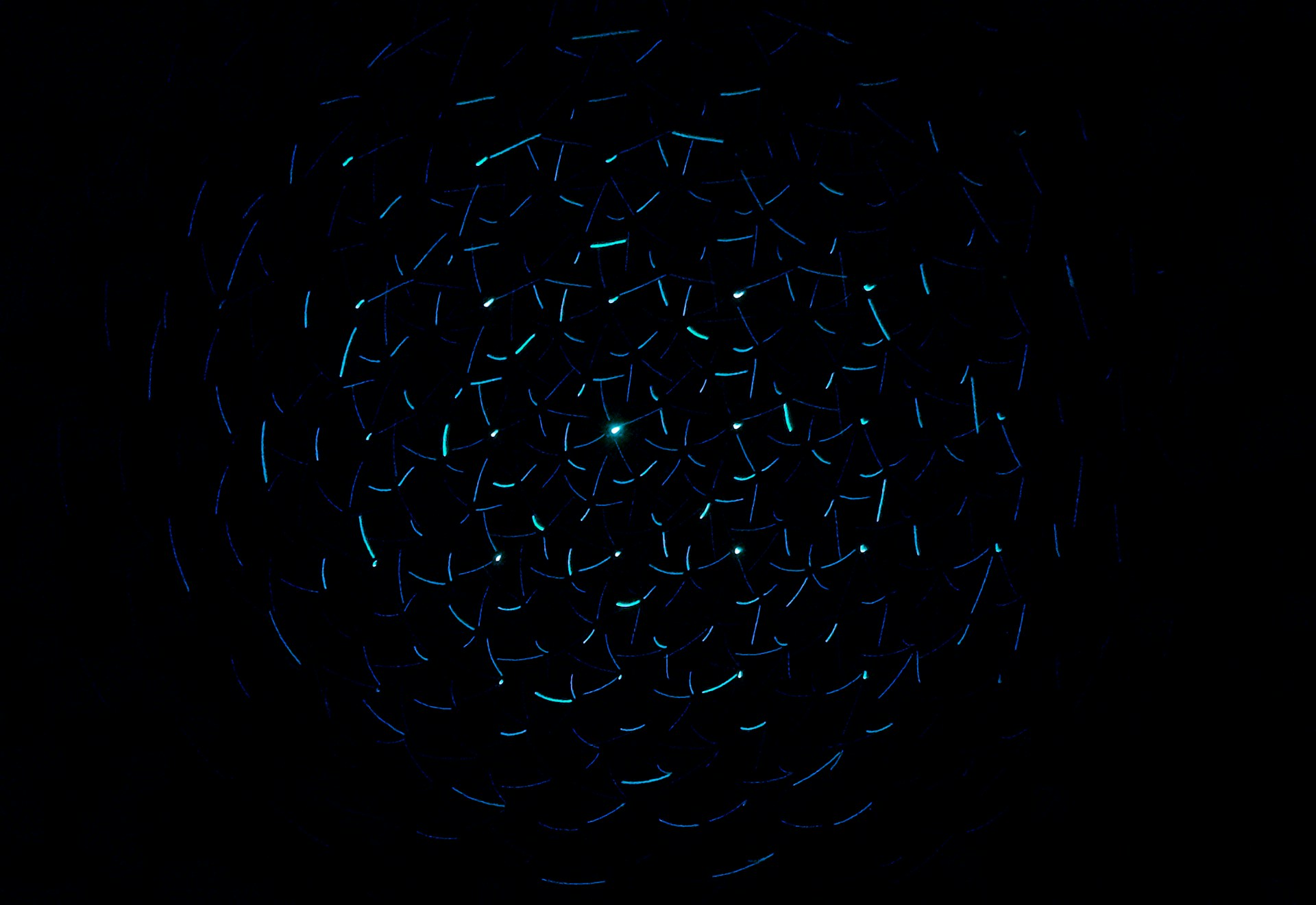
Microstructure of Reality
Before particles, before space — there was information.
Introduction
In the depths of the unseen, where reality is born from the smallest differences, lies the secret of all that exists. The F-Fabric Theory invites us to look into the microstructure of the world — not toward distant galaxies or blazing stars, but into the very foundation, where there are as yet no atoms, no fields, not even time itself, only a formless medium of potential.
Here, at the microscopic level, everything begins with simple distinctions: differences that learn to persist, intertwining into stable nodes and patterns. This is not a grand cosmological narrative, but an intimate story of how information, like countless tiny threads, weaves the fabric of being — from ephemeral states to complex structures, from dark matter to ordinary matter, from stellar processes to life and consciousness.
F-Fabric reveals that the micro is not merely a scale, but a key to understanding: aging as the loss of coherence, black holes as the ultimate compression of information. In the chapters that follow, we will descend into this microworld step by step, uncovering how all the complexity of reality emerges from the simple possibility of preservation, where every node marks a step toward self-awareness.
How the World Gradually Emerges from Information
Imagine a moment before the beginning of everything — a time when there were no stars, no planets, not even space itself to contain them. We are used to thinking of the world as a stage filled with actors: particles, fields, forces stretching across vast expanses. But what if we mentally erase this picture? Remove atoms, waves, dimensions, even the arrow of time steadily ticking forward. What remains in this emptiness?
The F-Fabric Theory offers a bold answer: nothing but pure possibility. This is not emptiness in the usual sense, but a formless medium in which differences — the very things that make reality real — can arise, cling to existence, or fade into nothingness. There are no predetermined rules or ready-made objects here. Everything begins with a simple question: what can survive in this ocean of potential?
Where Information Comes From
At the heart of this theory lies the idea that information does not arise out of nowhere like a sudden flash in silence. It is not created by some cosmic architect arranging bits and bytes into order. Instead, information emerges from a chaotic dance of differences — subtle distinctions between “this” and “that” that struggle to persist in being.
Imagine an endless fog where fleeting flashes appear: one shade slightly brighter than another, one rhythm slightly slower. Most of these differences are ephemeral. They flare up and vanish like sparks in the night, leaving no trace behind. But sometimes — rarely, yet inevitably — a difference finds support. It repeats, echoes in neighboring flashes, and suddenly… it holds.
This is not intention or purpose, but the simple logic of survival: everything fragile disappears, while what is stable remains, as if nature itself were filtering out the weak. Information, in essence, is a surviving difference — one that has learned to “remember” itself by maintaining coherence with its surroundings. It is not passive; it persists because, in this world, instability is synonymous with oblivion.
How Nodes Emerge from This Process
As these stable differences gain strength, they begin to form the first outlines of structure. Do not imagine solid spheres or geometric shapes — there is still no space to place them in. Instead, think of a process, a continuous flow in which information learns to repeat itself.
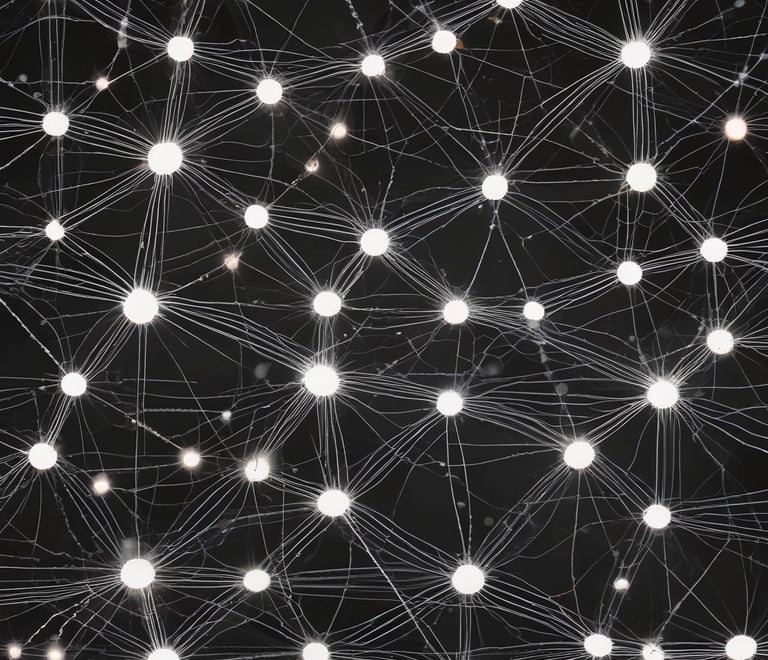
Where certain states — combinations of differences — begin to reproduce again and again, something emerges that F-Fabric calls a node. A node is not a static point, but a dynamic pattern in the fabric of reality, where chaos gives way to order. Imagine a river that suddenly forms a whirlpool: the water is the same, but now it moves in a stable rhythm, preserving its shape against the current.
A node appears in exactly this way — as a place where reality “remembers” itself, where information stops disintegrating and begins to build a stronghold. These are the first building blocks of the world, born not from matter, but from the persistence of preservation.
How Information Begins to Spread
Now imagine how these nodes begin to influence one another. Information does not move like a courier carrying a package across streets. There are no roads, no distances — only the process of reproduction.
If one node discovers a stable pattern, it is as if it whispers to its neighbors: “Try this.” And if that pattern is compatible, if it strengthens stability, neighboring nodes adopt it, repeating it in their own rhythms. This is not signal transmission through a wire, but more like the spread of a melody through an orchestra: one instrument begins to play, and soon the entire hall is filled with harmony — not because the notes have “moved,” but because they resonate, arising anew in each performer.
Gradually, the pattern spreads across more and more nodes, forming chains and networks. From this dance of reproduction will later emerge the illusion of motion — what we perceive as particles rushing through space. But at this stage, it is still a pure symphony of information, echoing through a formless medium.
When Structures Begin to Accumulate
Time flows — or rather, the experience of time emerges from the sequence of these events. Some patterns prove especially resilient. They do not merely survive, but accumulate, layer upon layer, shaping the surrounding fabric of reality.
This is the stage at which F-Fabric describes the emergence of what we call dark matter. Do not think of it as a mysterious substance hidden in the shadows. These are informational structures that have already gained stability but have not yet “manifested” in visible light. They barely interact with radiation — those more ephemeral patterns — yet they already form the framework of the future cosmos, like invisible roots nourishing a visible tree.
In this view, dark matter is accumulated memory — stable, quiet, laying the groundwork for everything that follows. It speaks of gravity and attraction, but in the language of pure coherence.
The Transition to Ordinary Matter
As evolution continues, structures grow more complex. They learn not only to persist, but to exchange, transform, and localize into denser configurations. From this activity arises baryonic matter — the ordinary substance of which we and everything around us are made.
In F-Fabric, this is not a sudden miracle, but a logical continuation: the same differences, the same nodes, now capable of a more dynamic dance. Matter is not a fundamental “thing,” but the highest form of long-lived coherence, where patterns interweave into atoms, molecules, and planets.
Imagine a symphony growing from simple notes: first a melody, then harmony, then a full orchestra. In the same way, substance emerges from stability, becoming tangible and interactive.
Stars as a Stage of Increasing Complexity
Next come the stars. Not merely giant balls of glowing gas, but true forges of information. In their interiors, under immense gravity and heat, stable patterns are reworked into new, more complex forms. What could not survive before — heavy elements, complex nuclei — now finds refuge in this fire.
Stars are engines of evolution, places where information “lives” long enough to mutate into diversity: from hydrogen to helium, to carbon, to iron. Then comes the explosion — a supernova — scattering these patterns across the cosmos like seeds. From atoms arise molecules, from molecules planets, oceans, and atmospheres.
Each step is a triumph of longevity, where information learns to become ever more complex.
Humanity as a Result, Not an Exception
And so we arrive at life, at consciousness — at ourselves. In conventional theories, life appears as an accident, a spark in a cold universe, and consciousness as a mystery alien to physics. In F-Fabric, this is not the case.
Human beings are a natural outcome of informational evolution — among the most refined patterns, capable not only of persistence, but of reflection. Life emerges when structures learn to self-reproduce, adapt, and evolve. Consciousness appears when information looks into a mirror — when it becomes aware of its own nodes, patterns, and memories.
We are not an exception to the rules of the universe; we are their culmination — where matter becomes thinking, and differences become ideas.
Why Nothing Lasts Forever: On Entropy
Yet nothing lasts forever. Every structure, no matter how complex, rests on fragile coherence. Over time — through random fluctuations, interactions, and decay — this harmony is disrupted.
In F-Fabric, entropy is not merely an increase of disorder, but an inevitable loss of information: patterns lose the ability to remember themselves, dissolving into simpler forms. It is like a symphony fading away — the notes still exist, but the orchestra falls apart.
At the microscopic level, this determines the lifespan of molecules, cells, and stars; on cosmic scales, it shapes the fate of the universe. And yet, even in decay there is continuity: the old gives way to the new, and the cycle continues.
What Happens Inside Black Holes
And what about black holes — those cosmic abysses? In F-Fabric, they are not graves of reality, but its ultimate repositories. Information is not destroyed; it is compressed to an extreme where familiar rules break down.
Beyond the event horizon, patterns are preserved in a maximally dense form, inaccessible to external observation. This is not an end, but a pause — an extreme form of stability, where space and time collapse into a point. What emerges from such compression remains an open question.
In Conclusion
Microstructure of Reality is an epic account of how the entire cosmos grows from modest differences clinging to existence. The world is not a static collection of things, but a living process: information learning to survive, to grow more complex, and to become aware of itself.
From hazy possibility to stellar symphonies, from dark matter to thinking minds — this is the story of an endless search for stability in an ocean of change.
Contact the Author
E-mail:
f.fabric.theory@gmail.com
© 2025 F-Field Theory Project. All rights reserved.